
Are you looking for “electrical safety penalties property owners”? In the UK, property owners can be penalised for ignoring electrical safety. Law requires safe installations, regular inspections, and valid Electrical Installation Condition Reports (EICRs). Failure can lead to enforcement notices, prosecution, property use restrictions, and civil fines of up to £30,000 per breach. Non-compliance may also affect insurance cover and trigger disputes or injury claims. Tenancies can be disrupted if serious risks are found. The sections below explain how these penalties arise and how to avoid them.
Key Takeaways
- UK property owners can face civil penalties up to £30,000 per breach for failing to hold a valid Electrical Installation Condition Report (EICR).
- Ignoring required electrical inspections or failing to fix identified defects can trigger enforcement notices, prosecution, and possible use restrictions on the property.
- Repeated or serious non-compliance increases penalty levels and damages the owner’s reputation with regulators, insurers, and tenants.
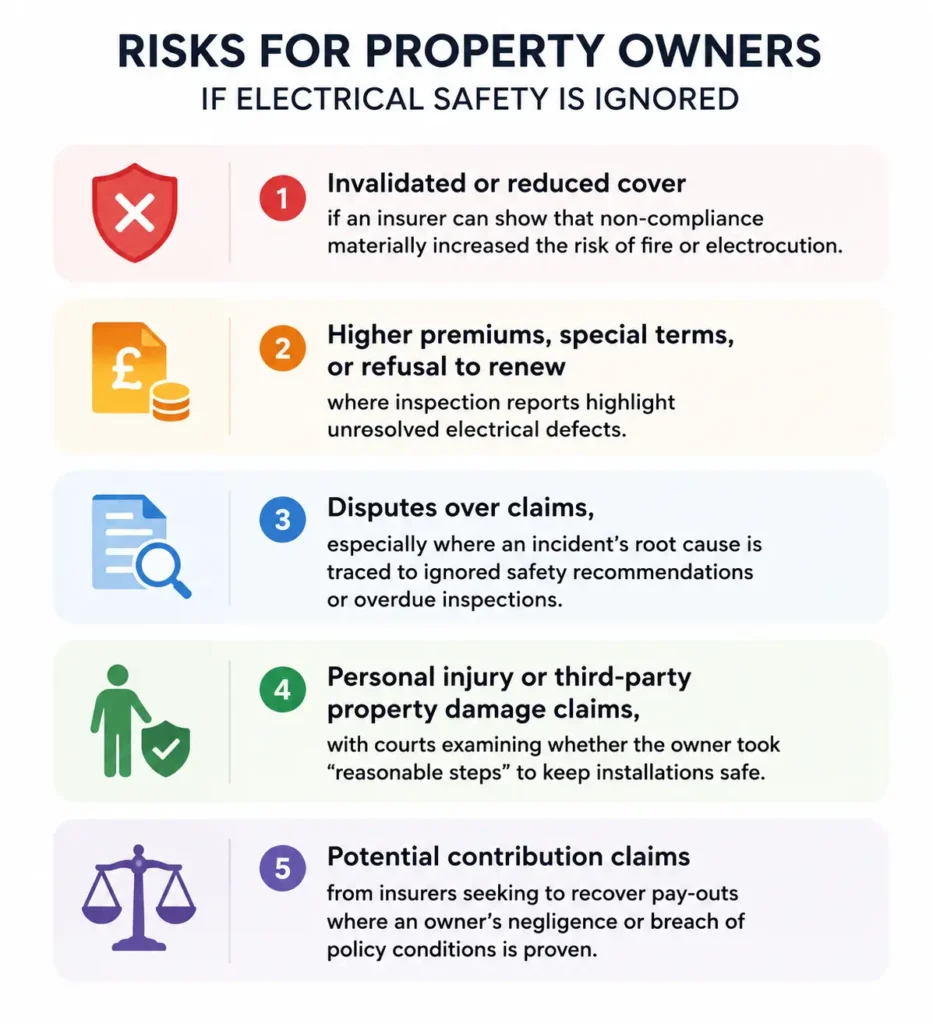
- Electrical safety breaches can invalidate or limit insurance cover, lead to higher premiums, and create disputes over claims after an incident.
- Tenants or visitors injured due to neglected electrical safety may bring personal injury claims, adding further financial and legal consequences.
Table of Contents
Why Electrical Safety Compliance Matters
Compliance with electrical safety standards protects property owners from legal penalties while reducing the likelihood of fires, electric shock, and costly damage. Beyond this, compliance matters because it provides a structured way to manage an often invisible risk. Faulty wiring, overloaded circuits, and neglected inspections may remain hidden until a serious incident occurs.
When a property follows recognised safety standards, the electrical system is more likely to perform reliably under everyday use. Tenants, employees, and visitors can use appliances, lighting, and equipment with greater confidence. Insurers also tend to view compliant properties as lower risk, which can influence cover and claims.
Compliance promotes regular testing, documentation, and timely repairs. This process helps identify small faults before they escalate into major failures or emergencies. As a result, electrical safety becomes a continuous practice rather than a one‑off exercise, supporting both asset protection and personal safety.

Legal Duties for Property Owners
While safety benefits are a strong incentive, property owners are also bound by specific legal duties that govern how electrical systems must be installed, maintained, and inspected. In the UK, these duties arise from housing law, health and safety regulations, and electrical standards such as BS 7671 (the Wiring Regulations).
Key responsibilities typically include:
- Ensuring all electrical installations are initially designed and fitted by competent, qualified persons.
- Keeping the installation in a safe condition throughout the life of the property, not only at the point of construction or purchase.
- Arranging periodic inspection and testing at legally required intervals, with written evidence retained.
- Acting promptly on any “unsatisfactory” or “requires improvement” findings noted in formal inspection reports.
- Providing relevant electrical safety documentation to tenants, managing agents, insurers, or enforcement authorities when requested.
These duties apply regardless of the owner’s technical knowledge; they are expected to use competent professionals to comply.
Penalties for Failing to Arrange Electrical Checks
Although electrical safety rules are often discussed regarding best practice, failure to arrange required electrical checks can lead to significant legal and financial consequences for property owners in the UK. When inspections are not carried out at the intervals required by relevant regulations or guidance, authorities may treat this as a breach of statutory duty or, in some cases, a failure to manage foreseeable risks.
Penalties can include formal enforcement notices, which compel the owner to organise inspections within a set timeframe and rectify any identified hazards. Ignoring such notices can escalate matters, leading to prosecution in the courts. In more serious situations, especially where people are placed at clear risk, the property may be restricted from use until safety can be demonstrated. Repeated or wilful non‑compliance can also damage an owner’s reputation with regulators, insurers, and potential occupants, making future property management more difficult and costly.
Fines for Landlords Without a Valid EICR
Beyond general enforcement measures, landlords who let properties in England without a valid Electrical Installation Condition Report (EICR) face specific financial penalties. These arise under the Electrical Safety Standards in the Private Rented Sector (England) Regulations 2020, which require periodic inspection and documentation.
Local authorities may investigate where they suspect no current EICR exists. If a breach is confirmed, they can impose a civil financial penalty rather than pursuing criminal proceedings. Key aspects typically include:
- A maximum civil penalty of up to £30,000 per breach
- Discretion for the authority to set the exact amount, reflecting severity and history
- Possibility of separate penalties for different properties or repeated non-compliance
- A requirement to serve notice of intent, giving the landlord an opportunity to make representations
- A right of appeal to the First-tier Tribunal, which can confirm, vary, or cancel the penalty
These fines aim to secure compliance and promote consistent electrical oversight. Check No Electrical Safety Report: What Happens if a Property Has No Electrical Safety Report?
Penalties for Unsafe Electrical Installations
Some of the most serious sanctions arise where an electrical installation is found to be actively unsafe, rather than simply lacking documentation. In these situations, enforcement moves beyond paperwork breaches and focuses on immediate risks of electric shock or fire.
Local authorities and regulators may issue legal notices requiring urgent remedial work or disconnection of the dangerous circuits. Failure to comply can lead to prosecution in the magistrates’ or Crown Court. Fines can be substantial, sometimes reaching unlimited amounts for the most serious offences under health and safety legislation.
Where conditions are judged to pose an imminent risk of serious harm, officials may prohibit use of the affected premises until repairs are completed and verified as compliant. In aggravated cases, individuals responsible for knowingly allowing hazardous systems to remain in service may face criminal liability, including the possibility of custodial sentences, particularly following injury or fatality.
Impact on Insurance and Property Liability
In addition to regulatory sanctions, unsafe or non-compliant electrical installations can considerably affect both insurance coverage and wider property liability. Insurers typically expect property owners to maintain systems in line with UK standards and may reassess risk the moment defects are identified.
Key consequences can include:
How Electrical Breaches Affect Tenancies
Electrical safety breaches do not only expose property owners to insurers and regulators; they also directly shape how secure and sustainable a tenancy is. When electrics are poorly maintained, tenants may experience power outages, faulty sockets, or overheating consumer units, undermining basic habitability and comfort. Repeated issues can erode tenant confidence, prompting early departures, tenancy disputes, or requests for rent reductions.
Such breaches also disrupt normal letting patterns. Prospective tenants increasingly ask for evidence of recent Electrical Installation Condition Reports (EICRs) and may avoid properties with a history of non‑compliance. Letting agents may be reluctant to market homes that could be unsafe, narrowing the pool of potential tenants and prolonging void periods.
In shared or licensed properties, concerns about overloaded circuits or missing RCD protection can heighten tensions between occupants and landlords, making renewals less likely and pushing tenants to seek alternative, safer accommodation. Read our blog post to find out EICR Fixed Wire Testing Difference/ EICR, Fixed Wire Testing and Electrical Safety Report: What Is the Difference?
What Happens After a Compliance Notice?
Once a compliance notice is issued, a clear sequence of enforcement steps is set in motion for the property owner. The notice typically sets out the defects, the legal basis, and a deadline for remedial work. From this point, the focus shifts from advisory guidance to formal oversight, with the local authority monitoring whether the owner responds within the stated timeframe.
After receiving the notice, the owner can usually:
- Arrange remedial electrical works by a competent, qualified electrician
- Provide evidence of completed works, such as installation certificates or updated EICRs
- Request clarification if any listed breach or timescale is unclear
- Challenge the notice through the specified appeals route, where the law allows
- Cooperate with follow‑up inspections to confirm that hazards have been removed
If the authority is satisfied that the breaches are remedied, the case will generally be closed. Failure to comply, however, usually escalates matters towards financial penalties or direct enforcement action. Here is the detailed guidance on Competent Person for Electrical Testing and Inspection: Who Is Competent to Carry Out Electrical Testing and Inspection?

Keeping Electrical Safety Records Updated
Beyond arranging inspections and repairs, property owners must also maintain accurate, up‑to‑date records of all electrical safety activities. In the UK, clear documentation helps demonstrate compliance if a local authority investigates or a tenant raises concerns. Well‑kept records can also shorten inspections, reduce disputes, and provide evidence that reasonable steps were taken to manage risk.
Key documents typically include:
- Dated Electrical Installation Condition Reports (EICRs), including observations and recommended actions.
- Invoices, job sheets, and certificates for remedial or upgrade work carried out by qualified electricians.
- Records of portable appliance testing (PAT), where applicable, with test dates and outcomes.
- Correspondence with tenants or managing agents about reported electrical issues and how they were resolved.
- A simple log summarising inspection schedules, next due dates, and completed safety actions.
Storing these records securely, in both digital and paper form where possible, guarantees they are accessible if enforcement or legal proceedings arise.
Frequently Asked Questions
Can Tenants Be Held Partly Responsible for Electrical Safety Issues in Rented Properties?
Tenants can be partly responsible when their misuse, damage, or failure to report faults contributes to electrical risks. However, landlords retain primary legal responsibility for installation safety, inspections, and ensuring the property meets UK electrical safety standards.
How Do Electrical Safety Penalties Differ Between Commercial and Residential Property Owners?
Penalties differ mainly in scale and enforcement. Commercial owners often face higher fines, possible business closure and prosecution, while residential owners usually receive improvement notices, moderate fines, or rent-repayment risks, escalating to prosecution for serious or persistent non‑compliance.
Are There Time Limits for Prosecuting Historical Electrical Safety Breaches?
Yes. In the UK, time limits apply: many summary offences must start within six months, but serious breaches under health and safety law can be prosecuted years later, especially where risks, injuries, or fatalities only later emerge.
Do Listed or Heritage Buildings Have Different Electrical Safety Penalty Rules?
Listed and heritage buildings do not face different penalty rules; general UK electrical safety law still applies. However, additional listed-building consent requirements may complicate remedial work, and breaches of heritage controls can create separate, parallel enforcement and penalty risks.
Can Electrical Safety Penalties Affect a Property Owner’s Personal Credit Rating?
Yes, electrical safety penalties can indirectly affect a property owner’s personal credit rating if they lead to unpaid fines, court judgments, or enforcement action, which may be reported to credit reference agencies and reduce credit scores.
Conclusion
To summarise “electrical safety penalties property owners”: In the UK, electrical safety is not optional for property owners. Legal duties, potential fines, and enforcement notices all underline the importance of arranging timely inspections and maintaining safe installations. Non‑compliance can damage tenancies, lead to significant financial penalties, and even result in prosecution. By scheduling regular checks, keeping EICRs and certificates up to date, and responding promptly to compliance notices, owners can protect occupants, safeguard their investment, and avoid avoidable electrical safety penalties.