
In the UK, a property with no electrical safety report may hide serious shock or fire risks. Landlords of most rented homes breach legal duties and can face fines of up to £30,000 per offence, enforcement action, and issues with insurance or letting the property. Tenants may complain to local authorities, triggering inspections and formal notices. Owners also risk unexpected repair costs and future sale problems. The next sections explain these consequences and solutions in more detail.
Key Takeaways
- Landlords of private rented homes and HMOs in England breaking EICR rules risk fines up to £30,000 per breach from local authorities.
- Tenants may challenge unsafe electrics, triggering inspections, enforcement notices, and legally enforced remedial works if no valid report exists.
- Without an EICR, hidden faults can go undetected, increasing risks of electric shock, fire, equipment failure, and expensive emergency repairs.
- Insurers may reduce, dispute, or refuse claims after an electrical incident if you cannot show evidence of reasonable electrical safety checks.
- For owner-occupiers, there’s usually no legal penalty, but lack of a report can cause problems when selling, remortgaging, or after electrical accidents.
Table of Contents
What Is an Electrical Safety Report?
An electrical safety report is a formal document that assesses the condition and safety of a property’s electrical installation at a specific point in time. It records whether wiring, circuits, consumer units, and accessories are functioning safely and in line with recognised standards. Rather than limiting choice, it supplies information so people can decide how much risk they are willing to accept.
The report usually follows a structured inspection and testing process. Test results and visual checks are recorded, along with any observed defects, wear, or non‑compliance. Each issue is coded by severity, showing what demands urgent attention and what may simply need monitoring or improvement. Crucially, an electrical safety report is not in itself a set of compulsory works. It highlights hazards and likely failure points, then leaves owners free to instruct repairs, upgrades, or further investigation according to their own priorities, budget, and appetite for risk.

Which UK Properties Need a Report?
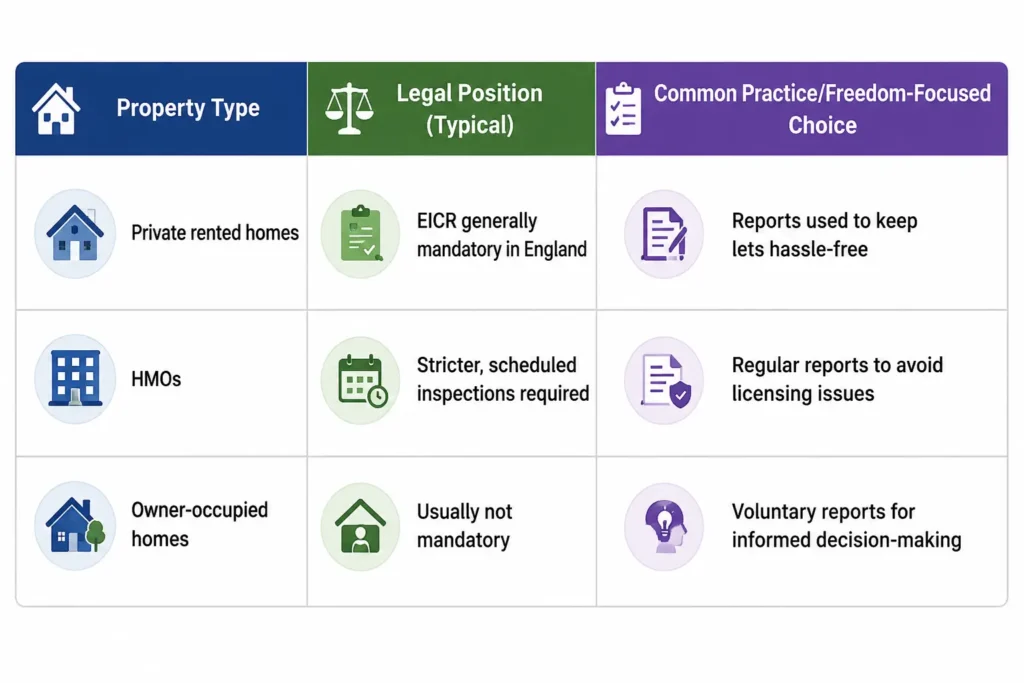
Knowing what an electrical safety report is naturally leads to asking where it is actually required in the UK. Legally, the strongest duties fall on landlords. Most private rented homes in England, and HMOs across the UK, must have a current Electrical Installation Condition Report (EICR) at specified intervals, with copies provided to tenants. Similar duties apply to social housing providers under housing and safety legislation.
Occupiers are not routinely compelled to obtain a report, yet surveys are strongly advised when buying, selling, or undertaking major works, particularly for those who value independence from unexpected hazards and costs.
Risks of Having No Electrical Safety Report
Without an electrical safety report, a property’s wiring and fixed installations may conceal faults that only become apparent through shocks, fires, or costly failures. Hidden defects; overloaded circuits, damaged insulation, outdated consumer units, or DIY alterations can quietly undermine safety, turning everyday use of electricity into an unnecessary gamble.
For those who value independence, the main risk is losing real freedom of choice when something goes wrong. An undiscovered fault can force urgent, expensive remedial work at the worst possible time, limit how a space can be used, or even render a home temporarily uninhabitable. Insurance providers may challenge claims after an electrical incident if no recent report exists, leaving owners financially exposed. There is also the risk of gradual damage to appliances and technology, shortening their lifespan and increasing reliance on reactive repairs rather than planned, on‑own‑terms maintenance.
Penalties for Non Compliance
Failing to obtain an electrical safety report in the UK is not just a technical oversight; it can trigger formal enforcement, financial penalties, and legal consequences. While the law sets a framework, each property owner ultimately chooses whether to comply, and bears the outcomes of that choice. Local authorities can impose civil penalties of up to £30,000 per breach for failing to obtain or maintain a valid Electrical Installation Condition Report (EICR), and repeated offences can attract multiple fines.
Key penalties typically include:
- Civil financial penalties Local authorities may impose significant fines per breach. These penalties can be repeated if non‑compliance continues, steadily eroding any short‑term “savings” gained by avoiding an inspection.
- Enforcement notices and orders Authorities can issue notices requiring remedial action within set deadlines. Ignoring these can escalate matters quickly, limiting the owner’s control over how and when work is carried out.
- Legal and administrative consequences Non‑compliance can lead to prosecution, a formal record of breach, and restrictions on certain landlord activities, reducing flexibility in how a property is managed or marketed.
Explore why EICR matters for property compliance.
Tenant Rights When No Report Exists
Even where a landlord has not provided an Electrical Installation Condition Report, a tenant in the UK retains explicit legal rights to live in a property that is safe from electrical hazards. Those rights arise from statutory obligations and cannot be signed away, even by contract. A tenant is entitled to challenge unsafe conditions and pursue remedies without fearing lawful retaliation, provided they act honestly and within the law.
Key rights include:
- Right to a safe home – The landlord must keep electrical installations in proper working order. Serious faults can justify demanding urgent repairs or, in extreme cases, ending the tenancy.
- Right to complain and escalate – Tenants may report hazards to the local authority, which can inspect and issue enforcement notices.
- Right to legal and financial remedies – Where disrepair is proven, tenants may seek compensation, rent repayment, or court orders compelling works, depending on the circumstances.
How Missing Reports Affect Property Lettings
While tenants retain strong legal protections when no Electrical Installation Condition Report (EICR) is provided, the absence of this document can still have significant consequences for the letting itself. Landlords may find their ability to market a property restricted, as many letting agents now refuse instructions without a valid report. Even where advertising proceeds, informed tenants often walk away from listings that lack clear evidence of electrical safety.
Mortgage lenders and insurers may also treat a missing EICR as increased risk, tightening conditions or raising premiums. This can limit a landlord’s financial flexibility and reduce overall returns, discouraging long‑term investment.
Where a tenancy goes ahead without an EICR, the landlord’s position weakens if disputes arise. Enforcement action, rent repayment orders, or difficulties regaining possession can all flow from non‑compliance, turning what should be a straightforward, mutually beneficial arrangement into a constrained and uncertain venture.
How to Arrange an EICR Quickly
Securing an Electrical Installation Condition Report (EICR) at short notice requires a structured and proactive approach. Speed matters, but so does maintaining control over cost and disruption. With the right steps, a landlord or owner can move fast without surrendering choice or paying inflated fees. Understand what happens during an EICR inspection.
To arrange an EICR quickly, they can:
- Prioritise qualified electricians They should search for NICEIC, NAPIT, or ELECSA-registered contractors, checking online reviews and availability filters to find those offering urgent or next‑day appointments.
- Prepare the property in advance Clear access to consumer units, sockets, and fixed appliances, and guarantee someone can grant entry. This reduces time on site and encourages contractors to accept short-notice bookings.
- Request clear quotes and timescales They should ask for written confirmation of the earliest appointment, duration, scope of testing, and total cost, avoiding vague estimates that threaten timelines or freedom of choice.
What to Do If the Property Fails
On receiving an EICR that records a failure, a landlord or owner should treat it as a compliance roadmap rather than a setback. The report’s C1, C2 and FI codes highlight where risk restricts their freedom to let, insure, or refinance the property. The first step is to prioritise C1 and C2 items, because these point to immediate or potentially dangerous faults that must be removed before the installation can be considered safe.
They would then typically gather quotes from qualified electricians, comparing costs, timescales, and the intrusiveness of proposed works. Clear written scopes keep control in the owner’s hands, ensuring only necessary remedial work is done. After completion, appropriate certification should be obtained to evidence that defects have been eliminated. The owner then commissions a follow‑up assessment or updated report, so there is documented proof the property now meets the legal and safety standards required for unrestricted use.
How Long an Electrical Report Remains Valid
How long an electrical report remains valid in the UK depends less on the paper itself and more on the legal and practical context in which it is used. For landlords in England under the Electrical Safety Standards in the Private Rented Sector Regulations, an Electrical Installation Condition Report (EICR) is generally treated as valid for up to five years, or sooner if the report specifies an earlier date.
However, validity is not a blanket permission to ignore change. Freedom to use a property as one wishes still sits within safety boundaries.
- Legal trigger points – New tenancy, licensing applications, or major alterations can make an older report effectively irrelevant.
- Condition-based limits – Code C1, C2, or FI observations usually demand immediate or prompt remedial work and fresh certification.
- Market-driven expectations – Buyers, insurers, and lenders may insist on more recent reports, often no older than 12–24 months.
Frequently Asked Questions
Can I Negotiate Rent if the Landlord Refuses to Provide an Electrical Safety Report?
Yes, they can negotiate. A tenant may leverage the landlord’s refusal as a bargaining chip: request rent reduction, break-clause flexibility, or permission to leave penalty‑free, while considering reporting safety concerns to local housing authorities.
Does Home Insurance Become Invalid Without a Current Electrical Safety Report?
Home insurance does not automatically become invalid, but many UK policies require legal compliance and may refuse claims if no valid electrical safety report exists. The individual should study policy wording and demand written clarification from the insurer.
Who Pays for Emergency Electrical Repairs When No Recent Safety Report Exists?
Typically, the property owner funds emergency electrical repairs, regardless of report status. Landlords usually pay in rentals, though tenancy agreements or negligence disputes may shift costs. Insurance might reimburse only if policy conditions and disclosure duties were already satisfied.
Can I Sue a Previous Owner for Not Disclosing Missing Electrical Reports?
They might sue, but success depends on sale documents, seller’s replies, and proof of misrepresentation or concealment. Limitation periods apply. They should gather paperwork, inspection evidence, then consult a UK property solicitor before committing resources.
Are DIY Electrical Checks Acceptable While Waiting for a Professional EICR?
DIY electrical checks are not an acceptable substitute for a professional EICR. An owner may visually inspect and test basic functions, but legal compliance, insurance validity, and tenant safety depend on certification by a qualified electrician.
Conclusion
In the UK, no electrical safety report leaves landlords and property owners exposed to legal penalties, financial loss and serious safety risks. An up‑to‑date EICR supports compliance, protects occupants and underpins smooth lettings or sales. Where issues are found, prompt remedial work and re‑inspection are essential. Given the report’s defined validity period, maintaining regular checks is the most reliable way to guarantee ongoing safety, legal conformity and long‑term protection of the property asset.