Choosing between Private Energy Efficiency Services vs Grant-Funded Schemes UK depends on budget, urgency, and control. Grants can offer the best short-term value by cutting or removing upfront costs, especially for low-income households. Private services often give better long-term savings through whole-house plans, flexible product choices, and clearer performance guarantees. Quality, waiting times, and eligible measures also differ. Understanding how each route affects bills, comfort, and carbon over time helps reveal which is truly a better value.
Key Takeaways
- Grant-funded schemes usually offer higher headline savings to eligible low-income households by reducing or removing upfront costs, but their coverage and availability are limited.
- Private energy-efficiency services can deliver greater long-term value for ineligible households through tailored designs, performance guarantees, and lifecycle cost optimisation.
- Grant schemes impose strict eligibility criteria and a limited choice of measures, while private services offer flexible upgrades, product options, and staged works aligned with homeowner priorities.
- Quality and communication are often more consistent with private providers; grant schemes can suffer from postcode lotteries, delays, and fragmented administration.
- Best value comes from comparing itemised quotes, projected bill savings, warranties, and finance costs for both options against your budget, property type, and comfort goals.
Table of Contents
Introduction to Energy Efficiency Choices in the UK
Energy costs and climate targets are hot topics in the UK, but many homeowners and landlords still find energy efficiency options confusing. Whether you live in a draughty Victorian home, a post-war estate, or a modern build, there are many rules, incentives, and services to consider when improving your property.
Tools like Energy Performance Certificates (EPCs), minimum efficiency standards for rental properties, and rising gas and electricity prices all push people to upgrade insulation, heating, windows, and smart controls. At the same time, you need to consider upfront costs, disruption during the work, how long it will take to save money, and whether the expected savings are realistic.
Changing policies, eligibility rules, and market prices make decisions about Private Energy Efficiency Services vs Grant-Funded Schemes UK even harder. Many households end up delaying upgrades, making small fixes here and there, or relying on inconsistent advice. Yet, taking a planned approach can cut energy bills significantly and lower carbon emissions over time.

How Private Energy Efficiency Services Work
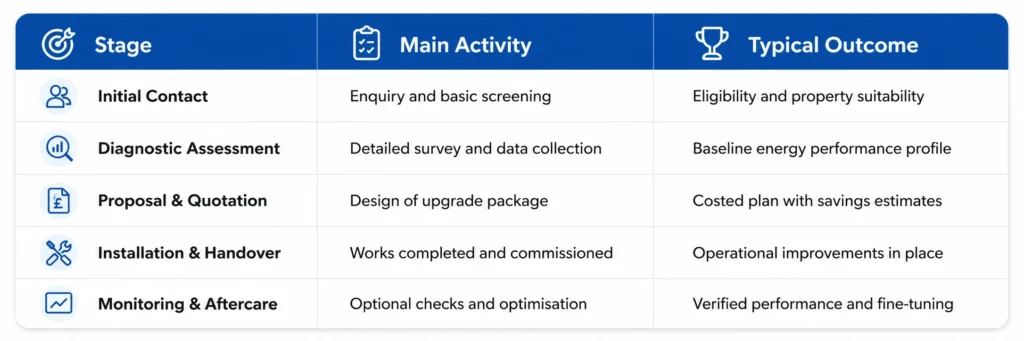
Many Private Energy Efficiency Services vs Grant-Funded Schemes UK providers in the UK operate end‑to‑end solutions that assess a property, propose tailored upgrades, and install or coordinate the works. Typically, they begin with a paid or discounted home survey, using tools such as EPC modelling, thermal imaging, or airtightness testing. The findings inform a package of improvements that might include insulation, low‑carbon heating, smart controls, or glazing.
These firms often provide clear quotations, performance estimates, and projected payback periods, allowing owners to choose measures based on budget and priorities. Financing options may include staged works, green loans, or “mix and match” upgrades over time.
How Grant-Funded Schemes Operate
Grant-funded energy efficiency schemes in the UK follow clear rules set by the government. They are designed to help specific groups and to fund upgrades such as insulation, heating systems, or low-carbon technologies. Local councils or energy suppliers often manage these programs.
The process usually starts with a check to see if your household qualifies, based on income, benefits, property type, or energy rating. If approved, an accredited assessor surveys your home and recommends improvements that follow the scheme’s rules, technical standards, and budget limits.
Only registered installers can carry out the work, and some homes may be inspected after installation to ensure everything meets requirements. Payments go directly from the funding body to the installer, not to the household, and detailed records are kept to demonstrate that the upgrades were completed correctly and that funds were used properly.
HSSE Solutions provides these UK grant funded schemes: Warm Homes Plan (WHP), ECO4 Scheme, Great British Insulation Scheme (GBIS), Social Housing Decarbonisation Fund (SHDF), Home Upgrade Grant (HUG), and Boiler Upgrade Scheme (BUS). These schemes are designed to support eligible households, landlords, and housing providers with energy saving improvements, insulation upgrades, heating system replacements, and low carbon technology installations. The exact support available depends on the scheme rules, property condition, household eligibility, and local funding availability.
Long-Term Savings Potential of Private Services
While fixed rules and funding limits bind public schemes, private energy-efficiency services can be structured around long‑term performance and whole‑house outcomes. This flexibility often translates into deeper, staged upgrades, such as combining insulation, airtightness, heating controls and on‑site generation, designed to compound savings over decades rather than a single funding window.
Because homeowners pay private providers directly, these services can focus on long-term savings: lower energy bills, less maintenance, and higher property value. Providers use detailed tools to predict energy use, payback times, and return on investment, helping homeowners make smarter decisions. As energy prices fluctuate and regulations tighten, these tailored, adaptive approaches can preserve or increase savings, giving homeowners more control over risk, comfort and long‑term running costs.
Financial Benefits of Grant-Funded Schemes
Although private services can release substantial long‑term value, publicly funded energy efficiency schemes in the UK deliver an immediate and often decisive financial benefit: they reduce or remove upfront costs. By covering measures such as insulation, efficient heating systems, or low‑carbon technologies, grants minimise the need for borrowing and protect households with limited savings from exposure to interest payments or credit checks.
These schemes also stabilise household budgets. Lower energy consumption turns into recurring bill reductions, which can be particularly valuable for low‑income or fuel‑poor households facing volatile energy prices. Some programmes additionally offer complementary support, such as energy advice, to help residents sustain their savings over time.
A simplified comparison of key financial advantages is shown below:
| Financial Aspect | Impact of Grant-Funded Schemes |
| Upfront capital required | Often reduced to zero |
| Exposure to borrowing costs | Greatly diminished or eliminated |
| Payback period | Shortened, as no capital needs to be recovered |
Installation and Service Quality Differences
Private energy efficiency services and grant-funded schemes often differ in how work is carried out and the level of service provided. With private providers, homeowners usually have more choice over materials, technologies, and installers. They can select companies with strong reputations, detailed warranties, and tailored support, which often lead to higher-quality installations and greater attention to long-term performance.
Grant-funded schemes, on the other hand, follow strict rules about who can install the upgrades and which materials can be used. Installers are registered with the scheme, and work must meet set standards. While this ensures compliance and safety, it can limit options and flexibility compared to private services.
In both cases, quality depends on careful planning, trained installers, and proper supervision. Private services may offer more personalised oversight, while grant-funded schemes focus on meeting regulations and documented outcomes. Understanding these differences helps homeowners choose the option that best matches their priorities for cost, convenience, and quality.
Risks and Limitations to Consider
Balancing the appeal of lower bills and subsidised upgrades against potential downsides, both private energy-efficiency services and UK grant‑funded schemes carry distinct risks and limitations. Private providers may promote products with higher profit margins rather than those best suited to a property, and some use aggressive sales tactics or complex finance arrangements that obscure true costs. Performance guarantees can be limited, leaving households exposed if projected savings fail to materialise.
Grant‑funded schemes, meanwhile, are constrained by eligibility rules, changing government priorities, and capped budgets. Households may face long waiting lists, geographic “postcode lotteries”, or sudden scheme closures. The choice of measures is often restricted to pre‑approved technologies, which might not address a property’s most pressing needs. In both routes, there is also a risk of disruption, poor communication, or inadequate aftercare, particularly where multiple subcontractors are involved, and accountability becomes difficult to trace.

Making an Informed Choice for Your Home
Recognising these risks, a homeowner must weigh options methodically rather than defaulting to the first offer or advertised grant. An informed choice begins with clarifying objectives: lower bills, warmer rooms, carbon reduction, or all three. From there, each route, private services or grant‑funded schemes should be judged on evidence rather than promises.
Key practical checks include:
- Whole‑house assessment quality: Is there a qualified surveyor using recognised standards (e.g., RdSAP/PHPP), and does the report prioritise fabric efficiency before technologies?
- Costing and payback transparency: Are quotes itemised, assumptions for savings clearly stated, and scenarios modelled for energy‑price changes and occupancy patterns?
- Assurances and accountability: What guarantees, artistry warranties, and redress routes (ombudsman, insurance‑backed guarantees, TrustMark, MCS, or PAS accreditation) are in place?
Frequently Asked Questions
Can I Combine Private Services With Government Grants for the Same Energy Upgrade?
Yes, combining is often possible, but rules vary by scheme. Applicants can usually use grants alongside private funding if they avoid double‑funding the same cost and use approved installers; always check the specific scheme guidance and installer terms.
How Do Energy Efficiency Improvements Affect My Home’s Resale Value and Marketability?
Energy efficiency upgrades generally increase resale value and widen buyer appeal by lowering running costs, improving comfort, and boosting EPC ratings. Documented improvements, warranties, and reputable installers further enhance perceived quality, making the property more competitive in its market segment.
What Protections Exist if an Installer or Scheme Provider Goes Out of Business?
Insurance-backed guarantees, manufacturer warranties, and consumer law rights typically protect them. In the UK, protections may include TrustMark safeguards, scheme administrator oversight, section 75 credit protections, and recourse via ombudsman or small-claims court.
How Do Energy Upgrades Impact My Home Insurance Premiums or Policy Conditions?
Energy upgrades can lower premiums if they reduce risks (better wiring, alarms), but may increase them if they add rebuild cost (extensions, solar). Insurers usually require notification, updated valuations, and evidence of professional installation and compliance certificates.
Are There Tax Implications or Reporting Requirements After Receiving Energy-Efficiency Funding?
Yes. Recipients may need to report grants as income, adjust property basis for capital gains, or claim reliefs. Requirements vary by scheme and jurisdiction; professional tax advice and careful record‑keeping are strongly recommended.
Conclusion
To summarise, both Private Energy Efficiency Services vs Grant-Funded Schemes UK offer UK homeowners viable routes to lower bills and reduce carbon emissions. Private providers typically deliver tailored solutions, faster installation and higher flexibility, while publicly funded schemes can greatly cut upfront costs. The best value depends on household income, property type, eligibility for grants and long‑term goals. By carefully comparing options, residents can choose the most cost‑effective, reliable path to improved comfort and lasting energy savings.