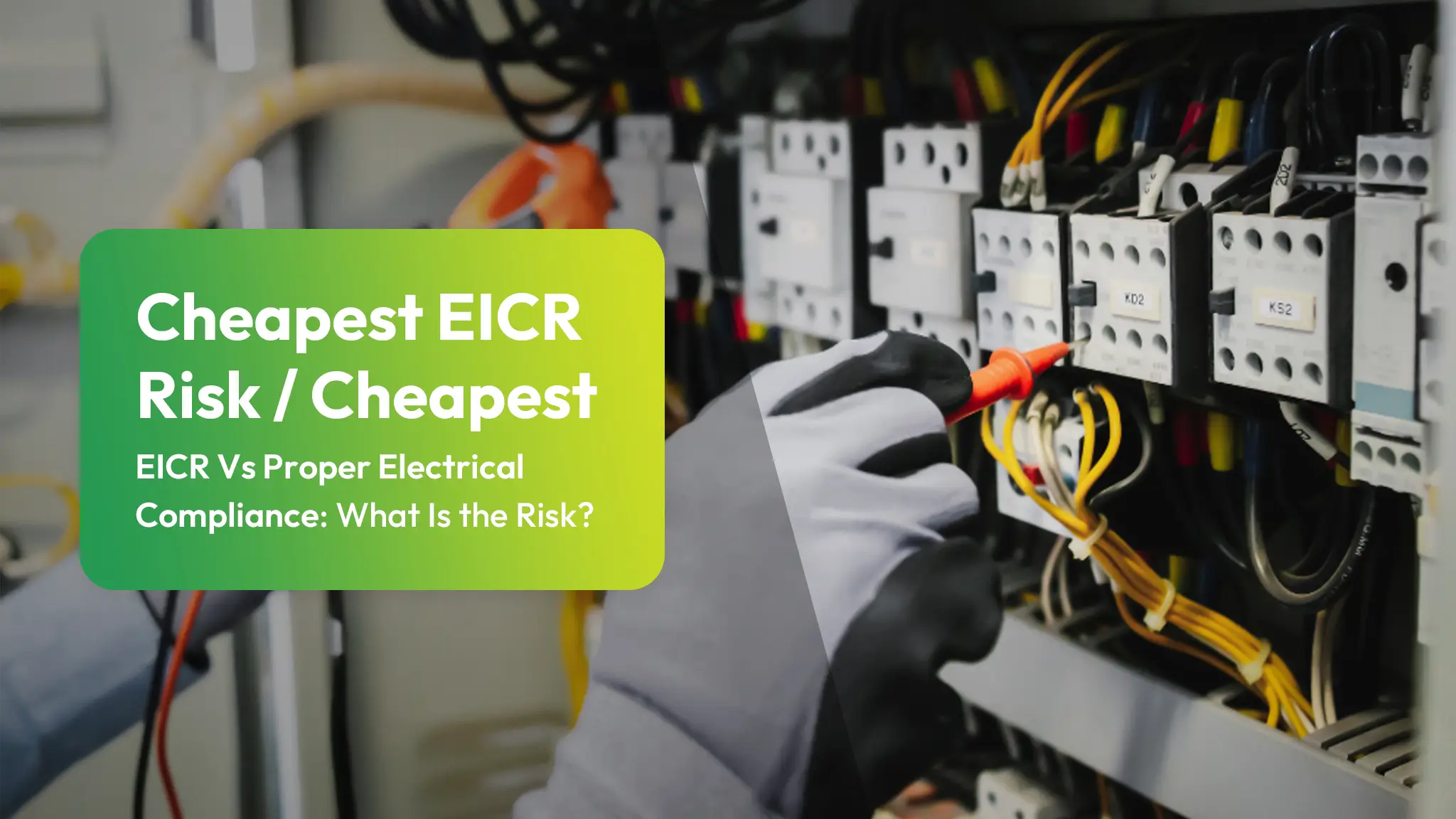
This guide will provide deep insight into the “Cheapest EICR vs Proper Electrical Compliance”. Choosing the cheapest EICR in the UK can mean rushed inspections, minimal testing, and missed defects in consumer units, wiring, and protective devices. Inadequate checks on earthing, bonding, RCDs, and insulation may leave serious fire or electric shock hazards undiscovered. Invalid or poor‑quality reports can also expose landlords and businesses to legal action, enforcement notices, and rejected insurance claims. A properly carried out, BS 7671‑compliant EICR offers far greater safety, assurance, and control, as becomes clear next.
Key Takeaways
- Cheap EICRs often skip essential testing, leaving dangerous faults, failed RCDs, and overloaded circuits undiscovered and occupants at serious risk.
- An invalid or poor-quality EICR can breach Electricity at Work Regulations, exposing duty‑holders to enforcement notices, fines, or prosecution.
- Insurers may reject claims if a defective, low‑quality EICR was relied on to demonstrate electrical safety and compliance.
- Proper EICRs by qualified, accredited contractors (e.g. NICEIC, NAPIT) include full testing, clear test values, and specific fault locations, enabling safe, compliant decisions.
- Choosing the cheapest quote over a competent provider often saves little, as missed defects lead to larger remedial costs, disruption, and reduced property usability.
Table of Contents
What a Proper EICR Inspection Should Include
A proper Electrical Installation Condition Report (EICR) inspection should begin with a thorough visual assessment of the installation, followed by systematic testing of circuits, protective devices, and safety systems. The assessor examines consumer units, wiring routes, earthing and bonding, and visible accessories to identify age‑related decay, damage, and non‑compliant alterations that could quietly limit a person’s control over their property.
Testing then verifies that each circuit behaves safely under fault and normal conditions. This includes continuity, insulation resistance, polarity, earth fault loop impedance, and RCD performance, measured with calibrated instruments, not guesswork. The inspector records results against current BS 7671 standards, grading observations by risk level.
A proper EICR also checks labelling, circuit identification, and accessibility of isolation points, ensuring occupants can act quickly and independently during an emergency. Finally, the report must be clear, evidence‑based, and usable for informed decisions, not just paperwork. Read our blog post What is Included in an EICR and What Needs a Separate Survey? To get detailed information.

What Cheap EICR Inspections May Fail to Check
Cheaper EICR inspections often cut corners by overlooking critical consumer unit safety issues, such as damaged enclosures or outdated protective devices. They may also fail to identify underlying wiring and circuit problems that only appear under proper testing conditions. In many cases, there is a poor or incomplete assessment of earthing and bonding arrangements, leaving serious faults undetected.
Overlooking Consumer Unit Safety Issues
Many landlords and property owners assume the consumer unit (fuse box) is fine if the lights work and breakers don’t trip often, yet this is precisely where the most serious risks can hide. A bargain‑price EICR often involves only a cursory glance at the board, ignoring ageing components, loose terminations, and inadequate fault protection. That neglect quietly trades genuine safety for a paper certificate.
| Key Area | Properly Checked | Often Missed in Cheap EICR |
| RCD protection | Trip times, coverage, test buttons | Assumed safe if “looks modern” |
| Consumer unit casing | Fire‑resistant, intact, correctly sited | Cracked lids, combustible enclosures |
| Labelling & isolation | Clear circuits, safe isolation points | Unlabelled ways, confusion in fault |
Such shortcuts restrict genuine freedom of use, replacing confidence with hidden compromise.
Failing to Identify Wiring and Circuit Problems
Rushing through an EICR almost guarantees that underlying wiring and circuit faults remain undiscovered. Cut‑price inspections often rely on a quick visual glance instead of deliberate testing, leaving hidden defects to threaten tenants’ safety and landlords’ legal position. When circuits are not properly checked, people unknowingly live and work with wiring that could fail without warning.
A rushed or cheap EICR may skip essential steps such as:
- Testing ring finals for continuity and identifying breaks that overload sections of cable.
- Confirming correct polarity at sockets, fittings, and accessories, which is crucial for safe disconnection.
- Measuring insulation resistance to reveal damaged, perished, or damp‑affected wiring buried in walls.
Missed faults restrict freedom of use, limiting confidence in every switch, socket, and appliance.
Poor Assessment of Earthing and Bonding Arrangements
Beyond missed wiring issues, low‑cost EICRs often give only superficial attention to earthing and bonding, despite these measures forming the primary path for fault currents to flow safely. When this assessment is rushed, occupants may unknowingly live with metalwork that can become live under fault conditions, undermining their ability to use the property freely and confidently.
Cheap inspections may skip verification of main protective bonding to gas, water, and structural steel, or fail to measure earth fault loop impedance properly. They might rely on visual assumptions instead of testing continuity and conductor sizes.
| Hidden Weakness | Real‑World Consequence |
| Missing main bonding | Shock risk from pipework |
| Undersized earth conductors | Inadequate fault disconnection |
| Loose terminations | Unpredictable touch voltages |
| No R2 continuity testing | Illusion of safety, no proof |
Risks of Incomplete Electrical Testing
A single skipped test or unchecked circuit within an Electrical Installation Condition Report (EICR) can quietly undermine the whole assessment, leaving serious faults undiscovered. When contractors chase the cheapest price, they often trim the schedule of inspections and tests, assuming no one will notice. Yet each omitted insulation resistance reading or RCD trip-time verification chips away at the reliability of the entire report.
The risks of such incomplete testing extend far beyond paperwork. Gaps in testing can allow hidden defects to remain energised, restricting the owner’s real freedom to use the property without worry. Key vulnerabilities often relate to:
- Overloaded or damaged circuits that are never stress‑tested under realistic conditions.
- Protective devices that are not functional‑tested, so may fail when needed most.
- Degraded insulation or ageing accessories that only thorough testing would reveal.

Poor Reporting and Missed Electrical Defects
Sloppy or vague EICR reporting can conceal as much as it reveals, turning a technical safety document into a dangerously misleading snapshot. When a cut‑price inspector rushes, essential detail is sacrificed: circuit identification is incomplete, test results are skimmed, and observations are copied from old templates rather than recorded from real inspection.
In this stripped‑down process, genuine defects can be missed entirely. Loose terminations, damaged insulation, underrated breakers, and deteriorated earthing may never be noted, even though they exist in plain sight. Instead, the report may contain generic phrases, unclear codes, or contradictions that make later scrutiny almost impossible.
For anyone who values control over their property and the freedom to use it without hidden constraints, this matters. An EICR that hides or blurs defects removes informed choice: owners cannot weigh risks, plan upgrades, or challenge poor workmanship because the true electrical condition is never clearly documented.
Impact of Incorrect EICR Observations
Incorrect observations within an EICR do more than simply understate risk; they actively distort the safety profile of an installation and can trigger costly or dangerous decisions. When codes are applied loosely or faults are misclassified, owners may be pushed into unnecessary work, or worse, lulled into a false sense of security while serious hazards remain live. This undermines informed choice and restricts the owner’s ability to manage their property on their own terms.
Incorrect observations can:
- Hide critical hazards – Mislabelled or missed defects can leave shock or fire risks unaddressed, while paperwork suggests everything is fine.
- Create financial traps – Overstated faults may justify needless remedial quotes, draining cash that could fund genuinely useful upgrades.
- Distort future planning – Flawed reports corrupt maintenance strategies, leading to repeated, intrusive visits and piecemeal work that erodes control, predictability, and long‑term confidence in the installation.

Compliance Problems With Invalid EICR Reports
When an EICR is invalid or poorly evidenced, compliance becomes a legal grey area that can fail under scrutiny from insurers, regulators, or the courts. Paperwork may look neat, yet lack test results, circuit schedules, or clear coding that prove the installation was actually checked. At that moment, a landlord or business owner can discover that the “cheap” certificate offers no real shield.
Invalid EICRs undermine statutory duties under the Electricity at Work Regulations and housing legislation, exposing duty‑holders to improvement notices, prohibition orders, or prosecution. Insurers may argue that a claim is void because the policyholder relied on a defective report, especially after an electrical fire or electric shock.
The result is loss of control: enforcement bodies dictate remedial work, insurers question cover, and tenants or employees challenge safety standards, eroding the freedom to operate, let, or trade on one’s own terms. Incorrect report means No Report, check out Can Property Owners Be Penalised for Ignoring Electrical Safety?
Choosing a Qualified EICR Provider
Cheap, poorly evidenced reports highlight why the choice of contractor matters more than the price on the quote. A landlord or freeholder who wants real freedom from anxiety, enforcement action and surprise remedial bills needs an EICR provider who is properly qualified, insured and accountable, not just cheap.
When choosing an inspector, the question becomes: who will actually protect the installation, the occupants and the long‑term value of the property?
A freedom‑minded client typically looks for:
- Proven competence – Current qualifications to BS 7671, inspection and testing credentials, and solid experience with similar properties, not one‑man “paper exercise” outfits.
- Recognised membership – Registration with NICEIC, NAPIT or equivalent, plus evidence of ongoing CPD and access to technical support.
- Transparent methods and limits – Clear explanation of what will be inspected, how long it will take, and how findings will be justified, so the client can make independent, informed decisions. Explore the details: Who Is Competent to Carry Out Electrical Testing and Inspection?
Checking the Quality of Electrical Reports
Many of the risks around EICRs only become obvious once the report is in hand, so the ability to judge its quality is as important as choosing the contractor. A genuinely protective report reads like a clear map of the installation, not a vague checklist. It should state circuits, test results, limitations, observations, and coding in a way that lets an owner make informed choices, not feel trapped in confusion.
Key emotional signals often appear between the lines:
| Signal in Report | What It Suggests | Emotional Impact |
| Clear test values | Real testing took place | Confidence, control |
| Specific fault locations | Engineer knew the installation | Calm, informed action |
| Honest limitations | Transparency about blind spots | Realistic freedom |
A poor report, by contrast, hides behind generic phrases, missing test readings, or copy‑paste observations, undermining the owner’s ability to manage risk on their own terms.
Frequently Asked Questions
How Often Should I Renew My EICR for Different Property Types?
They typically renew EICRs every 5 years for rentals, 10 years for owner‑occupied homes, or at change of tenancy. HMOs, commercial and industrial properties usually follow a 5‑year maximum, sometimes shorter if higher risk. Here is the guidance on frequency of EICR for every property type: How Long Is an Electrical Installation Condition Report Valid For?
Can I Be Fined if My Tenant Refuses EICR Access?
Yes, they can still be fined if they can’t prove they took all reasonable steps. They must document notices, emails, and offered appointments; this evidence usually protects them from penalties when a tenant repeatedly refuses access.
Does Landlord Insurance Become Invalid Without a Compliant EICR?
Landlord insurance does not automatically become invalid without a compliant EICR, but many policies require legal safety compliance. Insurers may reject claims or reduce payouts if no valid report exists, especially after electrical-related damage or injury.
Are EICR Requirements Different for HMOS Versus Single-Let Properties?
Yes. HMOs face stricter EICR expectations: mandatory five‑yearly inspections, stronger council enforcement, and licensing conditions. Single‑let properties follow the same legal cycle, but HMOs usually get more scrutiny, paperwork, and penalties when standards slip. Read out the EICR Requirements for HMOS Commercial Buildings and Standard Rentals.
How Do EICR Rules Apply When Selling or Remortgaging a Property?
EICR rules when selling or remortgaging aren’t yet universally mandatory, but lenders, buyers, and solicitors increasingly demand a recent satisfactory report, especially for rentals, HMOs, or older installations, to protect against hidden electrical risks and negotiation pressure.
Conclusion
Concluding, “Cheapest EICR vs Proper Electrical Compliance” In the UK, opting for the cheapest EICR instead of a thorough inspection can leave critical electrical defects undiscovered, undermining both safety and legal compliance. Incomplete testing, poor reporting and incorrect observations increase fire and electric shock risks, while also exposing landlords and businesses to enforcement action and invalid insurance. By choosing qualified, competent inspectors and checking report quality, duty holders can guarantee genuine compliance, reduce long-term costs, and better protect occupants and property.