This is the complete guide for “EICR requirements HMO commercial rental” In the UK, standard rentals and HMOs must have EICRs at least every five years, carried out by a qualified electrician, with urgent remedial work for C1/C2/FI issues. HMOs face stricter duties under the Housing Act 2004 and 2020 Regulations, including enhanced record‑keeping and potential local authority enforcement. Commercial premises must comply with BS 7671, often on shorter cycles due to higher loads and business use. The key differences, testing standards and landlord duties are explained further.
Key Takeaways
- HMOs, standard rentals, and commercial buildings all require periodic EICRs, typically every five years or sooner if the report recommends a shorter interval.
- HMOs have stricter legal duties: rapid remediation of C1, C2, and FI defects, plus mandatory sharing of reports with tenants and local authorities.
- Standard rental properties must give tenants copies of EICRs, complete remedial works promptly, and keep written proof of all corrective actions.
- Commercial buildings need EICRs aligned with BS 7671, often at shorter intervals due to higher loads, frequent alterations, and life-safety systems like emergency lighting.
- Good record-keeping of EICRs, remedial invoices, photos, and communication logs is essential to demonstrate compliance and satisfy insurers and enforcement bodies.
Table of Contents
EICR Rules for Standard Rental Properties
Most private landlords in the UK must comply with specific Electrical Installation Condition Report (EICR) rules designed to guarantee tenant safety and legal compliance under the Electrical Safety Standards in the Private Rented Sector (England) Regulations 2020. For standard rental properties, the EICR provides a snapshot of the fixed electrical installation’s condition, confirming whether it is safe for continued use. This protects tenants’ right to live without hidden electrical dangers and gives landlords clear evidence of due diligence.
An EICR must be carried out by a competent and qualified electrician. The document should be shared with new tenants before they move in, and with existing tenants within a reasonable time after inspection. Where the report identifies “unsatisfactory” items, remedial work or further investigation should be completed promptly, with written confirmation retained. Proper record‑keeping supports smooth lettings, fewer disputes, and a more flexible, low‑stress tenancy experience.
Electrical Safety Requirements for HMOs
In houses in multiple occupation (HMOs), electrical safety duties are stricter and draw directly on several key UK laws, including the Housing Act 2004, the Management of Houses in Multiple Occupation (England) Regulations 2006. These instruments impose tighter controls because unrelated adults share facilities and escape routes, so one person’s risk can quickly limit everyone’s freedom to live safely.
Landlords must guarantee a competent electrician undertakes an EICR at least every five years, or sooner if the report specifies. Defects coded C1, C2 or FI must be remedied rapidly, with written confirmation provided to tenants and local authorities.
| Requirement | Legal basis / effect |
| Five‑year EICR cycle | 2020 Regulations |
| HMO licence conditions | Housing Act 2004 |
| Safe fixed wiring and consumer unit | 2006 HMO Management Regulations |
| Record‑keeping and tenant access | 2020 Regulations |
| Local authority enforcement powers | Housing Act 2004 improvement and prohibition notices |
Electrical Compliance in Commercial Buildings
Commercial buildings face distinct electrical compliance pressures because they combine higher occupancy levels with business‑critical equipment and public access. Electrical installations must be designed, installed and maintained in line with the current edition of BS 7671, verified through a valid Electrical Installation Condition Report (EICR). Landlords, freeholders and business operators are expected to guarantee that fixed wiring, distribution boards, and safety devices remain demonstrably safe and suitable for ongoing use.
Regular inspection cycles are typically shorter than in residential settings because commercial sites carry higher load diversity, frequent alterations, and more intensive usage. Clear labelling, accessible isolation points and robust fault‑protection arrangements support both legal compliance and operational flexibility.
Emergency lighting, fire‑alarm interfaces and protective bonding must integrate with wider life‑safety systems, so that people can exit freely and safely when something goes wrong. Thorough record‑keeping of test results, remedial work and system changes protects both property interests and personal autonomy.

How EICR Duties Differ by Property Type
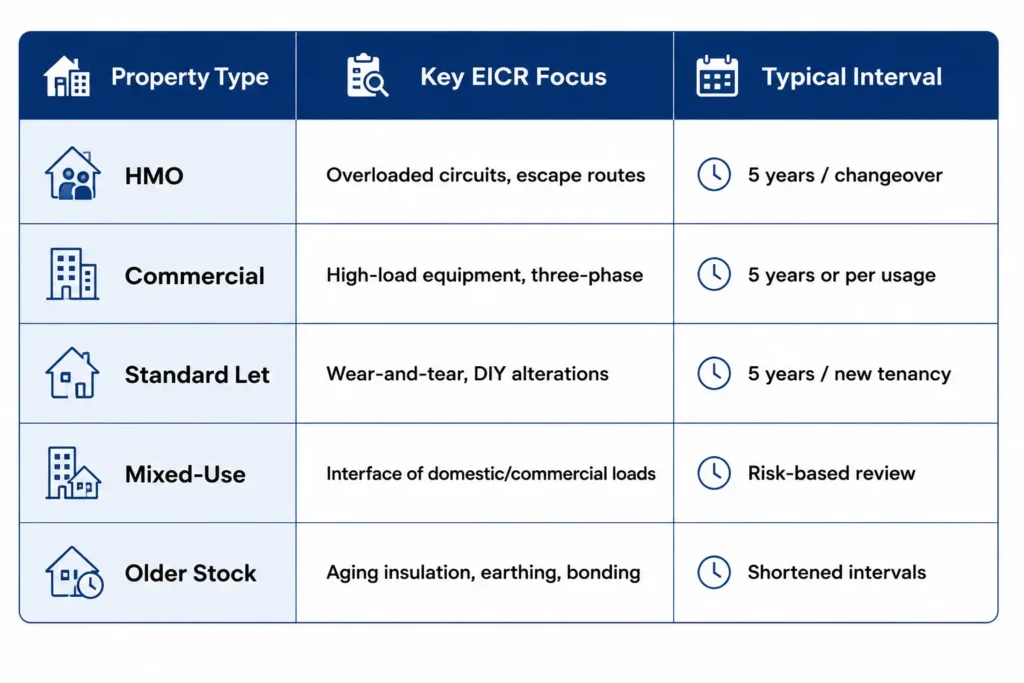
Although EICRs follow one core standard, the scope, frequency and legal triggers for inspection shift considerably between property types. HMOs, commercial premises and standard rentals each carry distinct duties that influence how much control owners truly retain over their buildings and risk exposure.
Key contrasts include:
- HMOs – Stricter statutory duties, detailed common‑area assessment and closer attention to overloaded circuits, as multiple unrelated occupants share facilities and escape routes.
- Commercial buildings – Duties hinge on business activity, staff/public access and specialised equipment; landlords and employers must align EICRs with health and safety law and insurance conditions.
- Standard rentals – Duties centre on ensuring tenants can use sockets, lighting and fixed appliances safely, with documentation ready for prospective and current occupiers.
- Mixed‑use properties – Landlords may face overlapping regimes, requiring clear separation of residential and commercial circuits and tailored reporting for each area.
Understanding these differences lets owners protect freedom of use while minimising regulatory friction.
Inspection Frequency for Rental Properties
Different duties across property types naturally raise the question of how often electrical safety should be checked in rentals. In most regulated markets, periodic EICR inspections are expected at intervals of around five years, or at a change of tenancy, whichever comes first. This rhythm aims to protect occupants without smothering landlords or agents in constant checks, allowing them to manage properties with a clear timetable.
| Aspect | Typical Expectation |
| Standard single lets | EICR at least every 5 years |
| HMOs | Often more frequent or tightly enforced |
| After major electrical works | Fresh EICR recommended |
| Change of tenant | Inspection or review strongly advised |
| Record keeping | Reports retained and shared on request |
Regular yet reasonable inspection cycles give renters confidence and give owners certainty, helping both sides enjoy safe use of the space with minimal interference. Here you can explore further: How Long Is an Electrical Installation Condition Report Valid?
Testing Requirements for Commercial Premises
Across non-domestic environments, EICR testing requirements become more stringent and nuanced, reflecting the higher occupancy levels, public access, and business-critical operations involved. Commercial premises must be tested against BS 7671, with attention to circuit loading, fault protection, and the integrity of safety devices. The goal is to keep people free to use spaces confidently, without hidden electrical hazards.
Different premises demand tailored approaches:
- Schools and colleges – focus on aging wiring, portable appliances, IT suites, and high-use communal areas.
- Hospitals and clinics – require rigorous verification of critical care circuits, backup supplies, and medical locations.
- Offices and co-working hubs – emphasise safe distribution boards, data-room supplies, and flexible plug-in workstations.
- Industrial units, leisure centres, and public parks – involve robust testing of three-phase machinery, outdoor lighting, EV chargers, and weather-exposed installations.
Test results dictate remedial priorities, ensuring systems remain safe, resilient, and adaptable.
Keeping Electrical Safety Records
Keeping clear, well‑organised electrical safety records is an essential component of complying with EICR requirements rather than an optional administrative extra. For owners and managers who value autonomy, records provide proof that they have taken control of risk rather than leaving outcomes to chance or assumption.
Proper documentation typically includes:
- Copies of all EICR reports, highlighting observations, coding, and overall assessment
- Evidence of remedial works, such as invoices, certificates, and photographs of corrected defects
- Dates of inspections, follow‑up visits, and scheduled future testing intervals
- Communication logs with electricians, letting agents, or insurers referencing electrical safety
Maintaining these documents in a secure but easily accessible format digital folders, cloud storage, or specialist compliance software, allows rapid responses to questions from insurers, local authorities, or tenants. Good records reduce disputes, demonstrate diligence, and give property decision‑makers the confidence to adapt, upgrade, or refurbish without being tied down by uncertainty about the existing electrical condition.
Staying Compliant Across Different Properties
How can landlords and managing agents maintain consistent EICR compliance when each property has different ages, uses, and electrical demands? They do it by building one flexible system, then tailoring it. Instead of reacting to inspections, they map every asset, HMO, commercial unit, or single let onto a central compliance schedule, with reminders locked to legal intervals and risk level. Read our blog post What Happens if a Property Has No Electrical Safety Report? To see the consequences.
They then adjust for reality: older wiring, high‑load businesses, or transient tenants. This approach protects freedom to grow a portfolio without losing control of safety duties.
Subject to inspector recommendations and local law.
Frequently Asked Questions
Can Tenants Request an EICR Copy Directly From the Electrician Instead of Landlord?
Tenants usually cannot demand an EICR copy directly from the electrician; the contract is with the landlord. However, tenants can request it from the landlord and, if refused, challenge this through local housing or regulatory authorities.
How Do EICR Requirements Apply to Listed or Heritage Residential and Commercial Buildings?
EICR rules still apply to listed and heritage buildings; electrical safety standards cannot be waived. However, remedial works must respect conservation constraints, using sympathetic methods, specialist materials, and sometimes alternative routes, agreed with conservation officers and competent electricians.
Are Smart Home Devices and EV Chargers Covered Within a Standard EICR Inspection?
Smart home devices and EV chargers are partly covered: the EICR checks their fixed wiring, supply circuits and protective devices, but not every smart feature. Responsible owners often request additional, device‑specific testing for maximum safety and flexibility.
What Happens if Insurers Discover an EICR Has Lapsed After an Electrical Incident?
Insurers may reduce or refuse payouts, argue contributory negligence, or even void the policy. The owner then faces repair costs, potential legal claims, and enforcement action, all for skipping a relatively simple, voluntary safety check.
Can a Single EICR Cover Mixed‑Use Buildings With Both Residential and Commercial Units?
Yes, a single EICR can cover mixed‑use buildings, but only if inspections clearly distinguish residential and commercial circuits, apply correct frequencies and standards to each, and insurers, freeholder, and any lenders accept that unified reporting approach.
Conclusion
Understanding how “EICR requirements HMO commercial rental”, vary between standard rentals, HMOs and commercial premises helps duty-holders stay compliant and protect occupants. By following UK legislation, observing correct inspection intervals and tailoring testing to each property type—from homes and offices to schools, hospitals and industrial sites—landlords and managers can manage risk effectively. Clear documentation, timely remedial work and consistent record-keeping underpin robust electrical safety and guarantee both legal compliance and long-term asset protection across diverse property portfolios.