

When is a retrofit coordinator required? A Retrofit Coordinator is required under PAS 2035 in the UK when domestic energy-efficiency works are carried out under regulated or government-backed funding, such as ECO or local authority schemes, especially where multiple or interacting measures are planned. They are typically mandatory for social housing and higher-risk homes or occupants. Private, self-funded projects may not legally need one, but using a Coordinator for complex or whole-house retrofits greatly reduces risk and offers further important advantages.
Key Takeaways
- A Retrofit Coordinator is required on PAS 2035-compliant domestic retrofit projects, especially where multiple energy efficiency measures are planned for a property.
- Coordinators are mandatory for government or regulated funding schemes (e.g. ECO, Home Upgrade Grant), and usually for social housing or local authority programmes.
- They are required where buildings or occupants are vulnerable to unintended consequences like damp, mould, or overheating from retrofit works.
- Whole-house, multi-measure or higher-risk projects (PAS 2035 Pathway B or C) generally require a Retrofit Coordinator to manage design, risks, and compliance.
- Private, self-funded projects may not legally require a Coordinator, but using one is strongly recommended for portfolio landlords or complex phased improvements.
Table of Contents
What Is a Retrofit Coordinator?
A retrofit coordinator is a qualified professional responsible for overseeing energy efficiency improvements in existing buildings, ensuring that all measures are designed, specified, and delivered in a safe, effective, and compliant manner. Operating within the PAS 2035 framework, this role exists to protect occupants, property owners, and public funds from poorly conceived or executed works that could limit choice or lock people into wasteful energy use.
The coordinator assembles and manages a team of specialists, draws together surveys and assessments, and creates a whole-house retrofit plan that respects the fabric of the building and the preferences of the occupants. They verify that installers follow agreed designs, that risks such as damp, overheating, or structural issues are considered, and that documentation is transparent and accessible. In doing so, the retrofit coordinator helps people pursue lower bills, greater comfort, and reduced carbon emissions without surrendering control of their homes.

When Is a Retrofit Coordinator Required?
Knowing what a retrofit coordinator does naturally raises the question of when one is actually required. Under PAS 2035 in the UK, the trigger is less about bureaucracy and more about risk, scale, and accountability. A coordinator becomes mandatory where multiple energy efficiency measures are planned, where the property or occupants are vulnerable to unintended consequences, or where public or regulated finance is involved and compliance is non‑negotiable.
To clarify how this shapes a homeowner’s options and responsibilities, the following table contrasts typical scenarios:
| Scenario type | Need for coordinator | Reason it matters for freedom |
| Single minor measure | Often not required | Minimal risk, more flexibility |
| Multiple upgrades | Commonly required | Guarantees coherent whole‑house strategy |
| Complex or high‑risk | Always required | Protects health, fabric, and long‑term autonomy |
In practice, the requirement signals when independent oversight is essential to safeguard both comfort and future choices.
Which Retrofit Projects Fall Under PAS 2035?
Often overlooked by homeowners, PAS 2035 in fact has a clearly defined scope: it applies to domestic retrofit projects where energy‑efficiency improvements are being installed, especially when funded or supported through government, local authority, or energy‑company schemes. This includes works under ECO, Home Upgrade Grant, Social Housing Decarbonisation Fund and similar programmes that can dictate eligibility and standards.
Any upgrade that changes how a dwelling uses or retains energy can fall within PAS 2035: insulation (loft, cavity, internal or external wall), new windows and doors, ventilation systems, low‑carbon heating (heat pumps, biomass, heat networks), solar PV, or significant controls and building‑fabric upgrades. Whole‑house, multi‑measure projects are squarely in scope.
Privately funded projects may also be brought under PAS 2035 if an installer, warranty provider, or financier insists on compliance. In practice, whenever public money or formal energy‑efficiency schemes are involved, PAS 2035 is the default route. Here you can explore PAS 2035 in detail: PAS 2035 Explained for Homeowners: How UK Retrofit Standards Work
Do Landlords Need a Retrofit Coordinator?
Surprisingly, there is no automatic legal requirement for every landlord to appoint a Retrofit Coordinator; the obligation depends on how the retrofit work is funded and procured. For landlords using government-backed schemes or funding tied to PAS 2035, a Coordinator is effectively mandatory. Where landlords commission works privately, they may have more discretion, but many still choose a Coordinator to cut risk, protect asset value, and avoid tenant disputes.
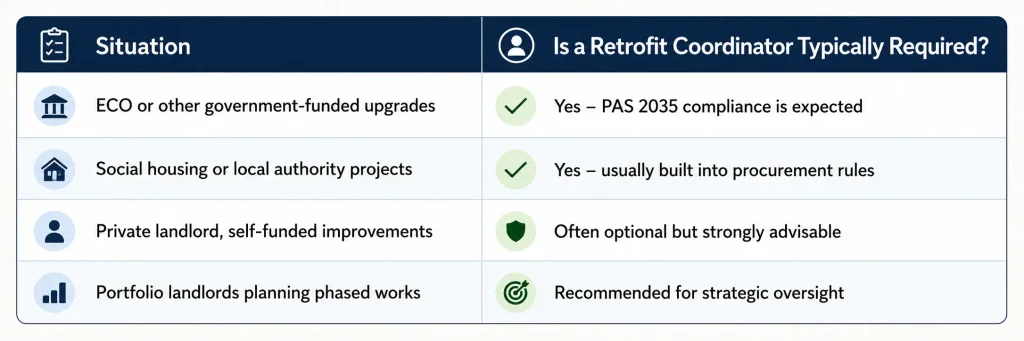
For landlords seeking maximum freedom, a Coordinator can be seen less as red tape and more as a tool: simplifying compliance, preventing costly failures, and enabling deeper, more confident retrofit decisions.
Do Homeowners Need a Retrofit Coordinator?
While landlords must weigh funding rules and procurement frameworks, individual homeowners face a different calculation. For an owner-occupied property, PAS 2035 only bites when work is delivered under a PAS-compliant scheme, often linked to formal quality assurance or particular funding arrangements. Legally, a private homeowner may still commission energy upgrades outside this framework, choosing advisers and installers on their own terms.
However, once a project is described as a PAS 2035 “domestic retrofit”, and especially where multiple measures interact, such as insulation, ventilation and heating upgrades , a Retrofit Coordinator becomes central. They oversee assessment, design, risk management and handover, reducing the chance of damp, overheating or underperformance. Freedom-minded homeowners may consequently view a Coordinator less as bureaucracy and more as a technical ally: someone who guards the long-term performance of their home, while allowing them to select measures, budgets and timescales that fit their own priorities.
Do Government-Funded Retrofits Require Coordination?
In most government-backed schemes, retrofit coordination is not optional but a built-in requirement tied directly to funding and compliance. Public money comes with conditions, and PAS 2035 places the retrofit coordinator at the centre of risk management, design oversight, and quality assurance. Where grants, subsidies, or obligations are involved, authorities usually insist on a named coordinator to protect occupants, the public purse, and long‑term performance.
The requirement is less about control for its own sake and more about ensuring work does not lock residents into poor outcomes, higher bills, or structural problems. Coordination becomes the safeguard that lets people accept funding without surrendering comfort or safety.
| Scheme Type | Typical Coordination Expectation |
| National energy efficiency | Coordinator almost always mandatory |
| Local authority grant | Usually required under funding rules |
| Social housing upgrades | Embedded coordinator role as standard |
| Utility‑obligation programmes | Coordinator required for PAS 2035 sign‑off |
When Is Coordination Not Required?
Government‑funded work may nearly always trigger the need for a retrofit coordinator, but not every retrofit project falls under such frameworks or risk levels. PAS 2035 focuses on risk‑managed, whole‑dwelling upgrades; outside that space, some activity can proceed without formal coordination. This creates breathing room for owners who want control without excessive oversight, provided they stay within defined limits.
Coordination is generally not required where work is:
- Limited to very low‑risk measures, such as replacing like‑for‑like heating controls or low‑energy lighting, with no impact on the building fabric.
- Purely maintenance or repair, restoring existing performance rather than upgrading thermal efficiency or systems.
- Undertaken outside government‑mandated schemes, funding routes, or accreditation frameworks that explicitly reference PAS 2035.
- Confined to a single, simple measure in a low‑risk property, with no interaction between systems or materials.
- Commissioned privately by an informed client who accepts responsibility for design choices and long‑term performance.

How to Confirm if Your Project Needs One?
So how does a homeowner or landlord actually determine whether a retrofit coordinator is mandatory? The starting point is to look at how the work is being funded and what standards the project must legally or contractually follow. If the project uses government-backed schemes, ECO funding, or any programme that explicitly cites PAS 2035, a coordinator is usually not optional. Next, the property owner should check the scope of works. Whole-house or multi-measure upgrades, changes that affect the building fabric, ventilation, or insulation depth commonly trigger the requirement.
They can then consult official guidance from TrustMark, scheme providers, or their installer’s documentation. Reputable contractors will confirm in writing whether PAS 2035 applies and, if so, who the appointed coordinator is. Finally, if there is any ambiguity, an independent PAS 2035 professional or energy advisor can review the proposal and provide a clear, written confirmation of the obligation.
How Does the Retrofit Risk Pathway Affect the Requirement?
Importantly, the retrofit “risk pathway” under PAS 2035 helps determine whether a coordinator is needed and what level of oversight is required. Each project is assigned to Pathway A, B, or C based on factors like building type, occupancy, and proposed measures. As risk increases, so does the obligation for structured control, documentation, and independent coordination.
Pathway A often allows lighter procedures; Pathways B and C trigger stronger requirements and make a Retrofit Coordinator effectively indispensable. This structure protects occupants’ comfort and safety while still leaving room for design choice and innovation.
Key influences within the risk pathway include:
- Scale and invasiveness of the energy efficiency measures
- Building age, construction type, and known defects
- Vulnerability of occupants and their specific comfort needs
- Interaction between multiple measures and whole‑house performance
- Funding route, compliance obligations, and assurance requirements
Frequently Asked Questions
How Much Does Hiring a Retrofit Coordinator Typically Cost in the UK?
Hiring a retrofit coordinator in the UK typically costs around £600–£1,500 per project, sometimes 1–3% of project value. Prices vary with property size, complexity, location, and whether the coordinator works independently or via installers.
What Qualifications and Certifications Should a Retrofit Coordinator Have?
They should hold Retrofit Coordinator certification via a TrustMark-approved provider, a Level 3+ qualification in energy efficiency or construction, demonstrable PAS 2035 training, plus strong project management, building physics, and retrofit risk assessment competence.
How Do I Find and Appoint a Qualified Retrofit Coordinator Near Me?
They search TrustMark’s register, professional retrofit bodies, or local eco-refurb networks, then compare PAS 2035 credentials, insurance, and past projects, finally appointing via a clear written contract that preserves choice, scope, and transparent fee structures.
Can a Retrofit Coordinator Also Act as My Installer or Designer?
Yes, one person can be coordinator, designer and installer, but only if independently qualified, accredited and insured for each role. They must still manage conflicts of interest, keep documentation transparent, and prioritise the homeowner’s informed choices.
What Happens if I Skip Using a Retrofit Coordinator When It’s Required?
Skipping a required retrofit coordinator exposes them to funding refusal, failed compliance checks, potential enforcement, unsafe or ineffective upgrades, insurance disputes, reduced property value, and future costs to redo work under proper oversight, undermining genuine long‑term autonomy.
Conclusion
To sum up, “When is a retrofit coordinator required?” A Retrofit Coordinator is central to guaranteeing PAS 2035 compliance, managing risk and safeguarding quality across domestic retrofit projects. Their involvement becomes essential where government funding, higher-risk measures or landlord obligations apply, while some low-risk or unfunded works may fall outside the standard. By checking funding conditions, project scope and risk pathway, property owners and landlords can determine whether coordination is mandatory and guarantee energy efficiency improvements are delivered safely, effectively and to regulation.