
What does a retrofit coordinator do? A Retrofit Coordinator under PAS 2035 is an independent professional who oversees domestic energy efficiency upgrades from assessment to handover. They review surveys, develop a whole‑house retrofit plan, and guarantee measures are compatible with the building and occupant needs. They manage risks such as moisture and ventilation, coordinate designers and installers, check on‑site quality, and maintain full documentation and compliance. Their role safeguards comfort, performance, and accountability, with the following sections explaining each duty in more depth.
Key Takeaways
- Oversees the whole-house retrofit process under PAS 2035, acting independently from installers to safeguard homeowner interests and project integrity.
- Reviews and verifies retrofit assessments, challenging assumptions and resolving conflicting data to ensure accurate understanding of the dwelling and its risks.
- Develops a phased retrofit plan that sequences compatible measures, manages moisture and ventilation risks, and aligns with homeowner goals and budget.
- Carries out quality assurance checks on-site, verifying workmanship, compliance, and documentation, and requiring corrective actions where standards aren’t met.
- Completes final checks, compiles handover documentation, and guides clients on operating and maintaining new systems for long-term comfort and efficiency.
Table of Contents
What Is a Retrofit Coordinator?
A retrofit coordinator in the UK is a qualified professional responsible for planning, overseeing, and managing domestic energy efficiency upgrades in line with PAS 2035. Operating independently from installers, this role protects the homeowner’s interests, ensuring upgrades are coherent, proportionate, and technically sound rather than piecemeal or sales-driven.
The coordinator assesses the dwelling, reviews risks, and curates upgrade pathways that respect how occupants actually live, helping them cut energy waste without being locked into a single technology or contractor. They verify that proposed measures are compatible with the building’s fabric and each other, so one choice does not undermine another or restrict future options. Acting as the central point of technical accountability, the retrofit coordinator integrates input from surveyors, designers, and installers into a single, transparent project record. This allows owners to make informed decisions, maintain control, and secure documented assurance about the work carried out.

Why PAS 2035 Requires a Retrofit Coordinator
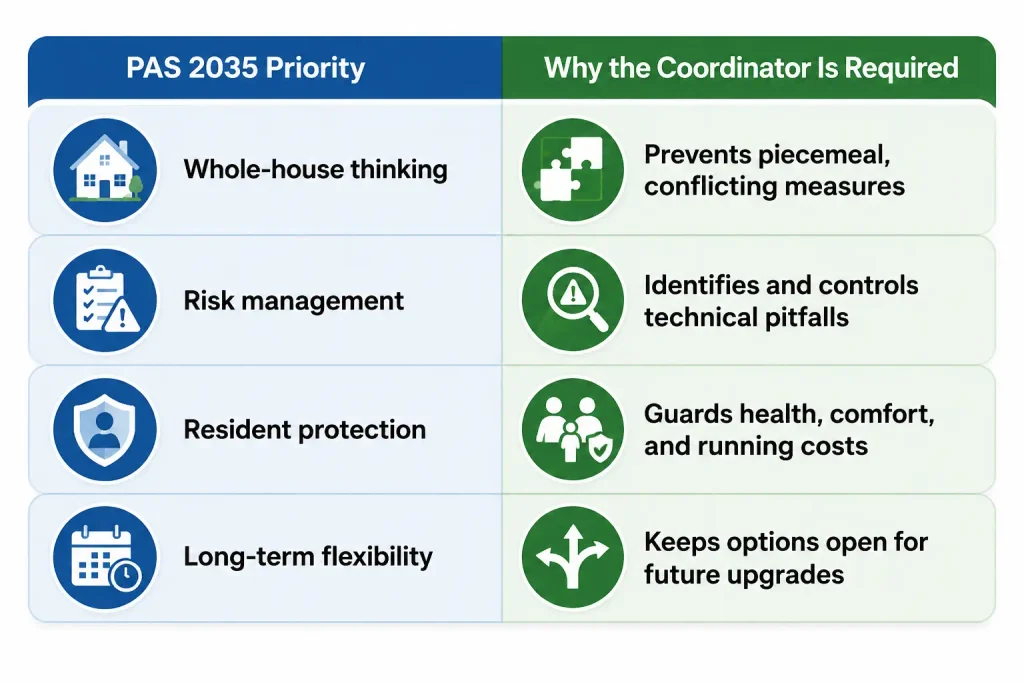
Because energy upgrades can easily cause unintended damage when planned in isolation, PAS 2035 mandates a retrofit coordinator to impose disciplined, whole-house oversight on every project. The role exists to protect occupants’ comfort, health, and long‑term control over their homes, rather than leaving results to chance or fragmented decision‑making.
At its core, PAS 2035 recognises that poorly sequenced or incompatible measures can trap moisture, worsen ventilation, or lock residents into higher running costs. A single accountable professional limits those risks and keeps design choices aligned with the homeowner’s goals, budget, and appetite for change. Here is the detailed guide on What Is PAS 2035 Retrofit? a Complete UK Guide to Retrofit Standards
Reviewing the Retrofit Assessment
Serving as the project’s critical checkpoint, the retrofit coordinator reviews the completed assessment to verify that every survey finding is accurate, consistent, and technically robust before any design work proceeds. They interrogate the data, challenge assumptions, and confirm that the home’s condition, occupancy patterns, and energy use are captured honestly, not bent to fit a pre‑chosen solution.
The coordinator checks that moisture risks, ventilation routes, thermal bridges, and structural issues are correctly identified and evidenced. Conflicting information from different assessors or tools is resolved, not ignored. Any gaps in photos, measurements, or monitoring data are flagged and sent back for clarification or further inspection. If you are a homeowner, you must know What Happens After a Retrofit Assessment? A Homeowner’s Next Steps
Creating the Retrofit Plan
With a verified assessment in hand, the retrofit coordinator moves from scrutiny to strategy, assembling a coherent plan that sets out what will be done, in what order, and why. This retrofit plan becomes the project’s backbone under PAS 2035, defining the upgrade path without trapping the homeowner in a single rigid route.
The coordinator sequences measures so that fabric, ventilation, and services work together rather than clash, reducing technical risk and avoiding lock‑in that could limit future choices. They test scenarios against moisture, thermal comfort, and energy targets, ensuring the plan respects both the building’s limits and the occupant’s appetite for disruption, cost, and control.
They also map dependencies, indicative timescales, and performance outcomes, making explicit how each measure advances comfort, resilience, and lower bills. The resulting document is a transparent roadmap, giving the client informed freedom to phase works while still complying with PAS 2035.
Coordinating Retrofit Designers and Installers
Bridging analysis and execution, the retrofit coordinator turns the plan into coordinated action by directing the work of designers and installers. They guarantee the project brief, PAS 2035 requirements, and the homeowner’s priorities are clearly translated into design instructions and installation sequences, so no party is left guessing or constrained by confusion.
The coordinator convenes designers, installers, and assessors, aligning them around agreed performance outcomes, programme, and access arrangements. They check that drawings, product specifications, and installation methods fit the whole‑house strategy, preventing piecemeal decisions that might lock the occupant into future limitations or unnecessary disruption.
They also manage information flow: issuing design updates, collecting installer feedback, and confirming that any site changes are documented and approved before work proceeds. Throughout delivery, the coordinator acts as the single, accountable point of contact, keeping decisions transparent so the homeowner retains visibility, choice, and control over how their home is transformed.
Managing Retrofit Risks
Managing retrofit risks sits at the core of the retrofit coordinator’s role under PAS 2035, turning potential technical, financial, and occupant‑related pitfalls into controlled, documented elements of the project plan. Instead of allowing risks to restrict choices, the coordinator maps them transparently so clients can still pursue ambitious outcomes with open eyes.
They begin by identifying threats such as moisture, thermal bridging, fire safety, ventilation shortfalls, cost overruns, and disruption to daily life. Each risk is evaluated for likelihood and impact, then logged in a formal risk register that stays live throughout the project.
The coordinator then proposes proportionate mitigation strategies: sequencing works to avoid trapped moisture, aligning measures with budgets, scheduling intrusive tasks around occupancy patterns, and ensuring design decisions do not lock residents into uncomfortable or unhealthy conditions. By making risks explicit and manageable, the coordinator protects both performance goals and the client’s freedom of choice.
Checking Quality and Compliance
Once risks are identified and mitigations agreed, the retrofit coordinator’s focus turns to verifying that the works delivered on site actually meet the agreed standards, specification, and legal obligations. Under PAS 2035, this means inspecting installations against the design, checking that materials and methods are appropriate, and confirming that contractors have not cut corners that could compromise building performance or occupant autonomy.
The coordinator typically uses structured site inspections, photographic evidence, and test results to confirm that insulation, ventilation, airtightness, and services are installed correctly and safely. They challenge poor workmanship, require corrective actions, and guarantee that any changes are justified and formally agreed, not imposed on the household by convenience or habit.
Maintaining PAS 2035 Records
Maintaining PAS 2035 records requires the retrofit coordinator to create a clear, auditable trail of decisions, designs, installations, and outcomes for every project. This record-keeping is not box-ticking; it protects the client’s right to understand what has been done to their home and why. It also shields projects from disputes by showing how risks and options were weighed.
The coordinator assembles documents from assessment through design and installation: surveys, calculations, risk assessments, specifications, product data, photographic evidence, change logs, and site reports. They guarantee each version is dated, traceable, and linked to the dwelling and measures installed. Digital systems are usually used to store and index records, but the coordinator must keep them accessible, not locked behind obscure file structures or jargon. Good records enable transparent comparison of planned versus actual work and make it easier for occupants to adapt, improve, or challenge decisions in future.

Final Checks and Project Handover under PAS 2035 Compliance
At the final checks and project handover stage, the retrofit coordinator verifies that every measure has been installed, commissioned, and documented in line with PAS 2035 and the agreed design. This step guarantees the dwelling performs as promised, giving occupants genuine control over comfort, costs, and carbon impact.
The coordinator independently reviews evidence from installers, on-site inspections, and tests before signing off the project. Any defects or non-compliance are challenged and resolved before responsibility is formally transferred to the client.
Key tasks typically include:
- Quality and performance verification – confirming measures match the design, interface correctly, and do not introduce moisture or ventilation risks.
- Documentation and compliance pack – compiling warranties, product data, test results, photographs, and updated risk assessments into a clear handover file.
- Client handover and guidance – explaining how systems operate, what maintenance is needed, and how to use controls to maximise efficiency and comfort.
Frequently Asked Questions
What Qualifications and Training Are Required to Become a Retrofit Coordinator?
Becoming a retrofit coordinator typically demands Level 3+ construction or building-services qualifications, PAS 2035/2030 training, TrustMark registration, retrofit-coordinator certification, CPD, plus practical retrofit experience, equipping individuals to navigate regulations while enabling low-carbon, occupant-focused design freedom.
How Much Does Hiring a Retrofit Coordinator Typically Cost per Project?
Hiring a retrofit coordinator typically costs £800–£2,500 per project, scaling with property size, risk level, and complexity. Fees may be fixed or staged, but transparent pricing lets clients compare options and choose freely aligned expertise.
Who Is Legally Responsible if the Retrofit Coordinator Makes an Error?
Legal responsibility usually rests with the installation contractor and principal designer, not the retrofit coordinator, though coordinators may face professional negligence claims. Ultimately, liability flows from contracts, insurance, and consumer law, empowering clients to challenge poor or damaging work.
How Does a Homeowner Find and Select a Qualified Retrofit Coordinator?
A homeowner searches TrustMark or equivalent registers, checks PAS 2035 accreditation, insurance, and experience, compares references and example projects, interviews multiple coordinators, clarifies fees and responsibilities in writing, and chooses the one aligning with their retrofit ambitions.
Can One Retrofit Coordinator Manage Multiple Projects at the Same Time?
Yes, a retrofit coordinator can manage multiple projects simultaneously, provided they maintain rigorous oversight. They must balance time, compliance, and communication, ensuring each homeowner’s chosen measures are delivered safely, efficiently, and without compromising quality or regulatory obligations.
Conclusion
To sum up, “what does a retrofit coordinator do” The retrofit coordinator plays a central, regulated role in delivering PAS 2035-compliant projects. By reviewing assessments, designing robust retrofit plans, coordinating designers and installers, and managing risks, they help guarantee measures are appropriate, safe, and effective. Their oversight of quality checks, documentation, and final handover safeguards building performance, resident wellbeing, and long-term value, making the retrofit coordinator an essential professional within the UK’s whole-house retrofit process.