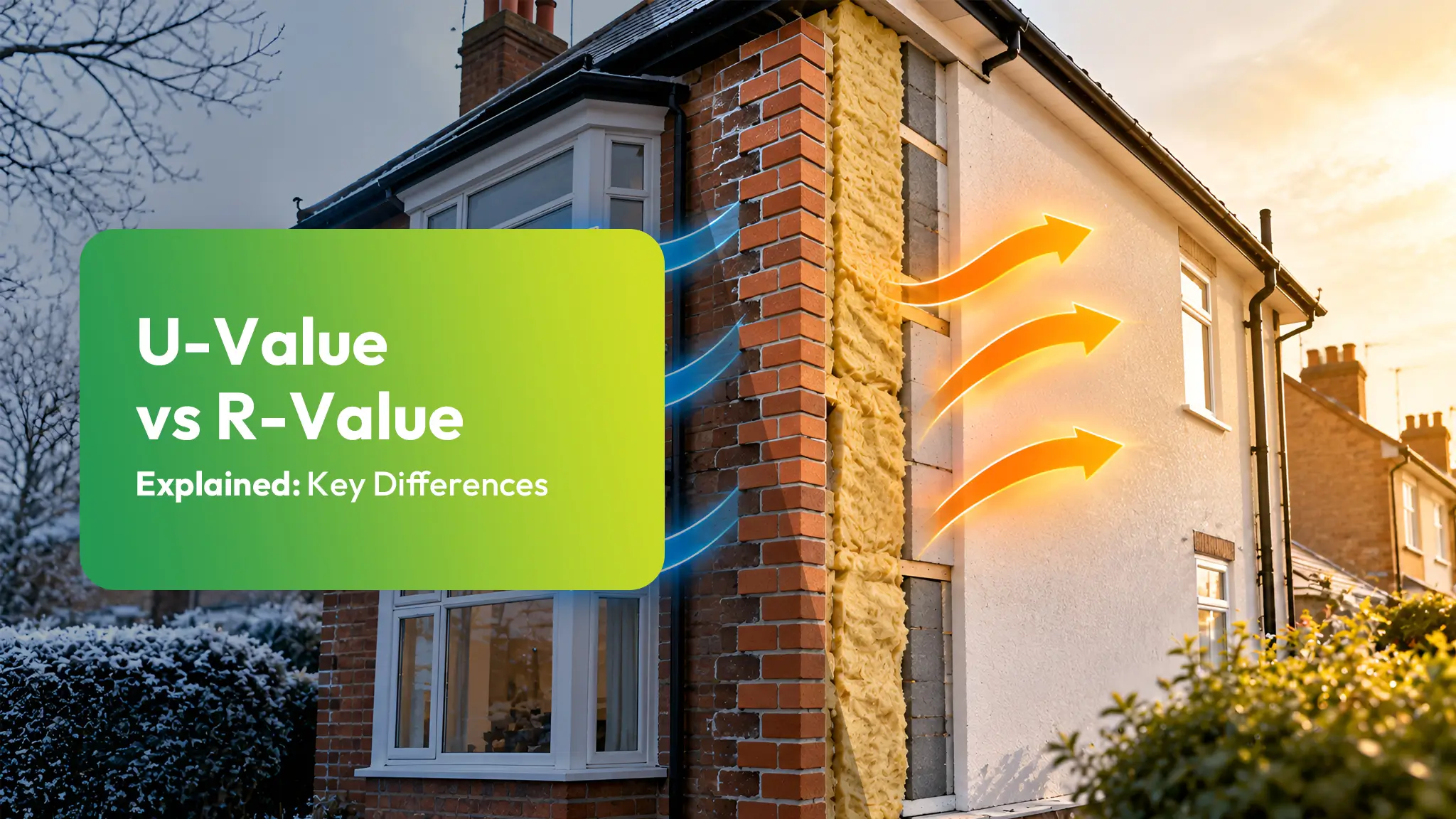
In the UK, U-values and R-values describe heat performance but from opposite angles. A U-value (W/m²K) measures how much heat passes through a building element; lower is better and it is central to Building Regulations. An R-value (m²K/W) measures how strongly a material resists heat flow; higher is better and it is common on insulation products. Understanding how they relate helps with choosing materials, meeting UK standards, and improving overall building efficiency, as is outlined next.
Key Takeaways
- U-value measures how much heat passes through a building element (W/m²K); lower U-values mean better overall insulation and less heat loss.
- R-value measures how strongly a material resists heat flow (m²K/W); higher R-values mean better insulation performance for that layer.
- U-value applies to complete elements like walls, roofs, and floors, while R-value is usually quoted for individual insulation materials or layers.
- In the UK, Building Regulations set maximum U-values for elements; R-values mainly help compare and select insulation products.
- U-value is calculated as the inverse of total thermal resistance (U = 1 / ΣR), combining all material layers, air gaps, and surface resistances.
Table of Contents
What Is a U-Value?
A U-value is a numerical measure of how readily heat passes through a building element such as a wall, roof, window, or floor. It expresses the rate of heat transfer per square metre for every degree of temperature difference between inside and outside, with units of W/m²K. The lower the U-value, the less heat escapes, and the easier it becomes to control indoor conditions without constant reliance on heating or cooling systems.
In the UK context, U-values are central to Building Regulations and energy performance certificates, setting limits on how “leaky” a structure may be. They are calculated from the combined performance of all layers in a construction, including insulation, structural materials, air gaps, and surface resistances. For someone seeking lower running costs, reduced environmental impact, and more independence from energy markets, U-values provide a clear, comparable way to judge how efficiently a building shell holds onto heat.
What Is an R-Value?
R-value describes how strongly a material or building component resists heat flow, with higher numbers indicating better insulation performance. In simple terms, it measures how effectively a product slows heat moving through it. An R-value is usually expressed in m²K/W in the UK, reflecting both the material’s thermal resistance and its thickness.
R-values are commonly used for insulation such as loft rolls, rigid boards, and cavity wall products. Each layer in a building element has its own R-value, and these individual values can be added together to show the total resistance of that element. This helps people choose constructions that hold on to warmth in winter and limit overheating in summer.
For those who value independence over energy costs, R-value becomes a practical tool: it allows comparison between products and supports decisions that reduce reliance on mechanical heating and cooling.

U-Value vs R-Value: Key Differences
Understanding how R-value works naturally raises a question about its counterpart, U-value, and how the two relate. R-value measures resistance to heat flow; U-value measures the rate of heat transfer. In simple terms, R-value looks at how strongly an element resists losing heat, while U-value shows how easily heat passes through. For someone seeking control over energy use and comfort, both matter.
The key difference lies in direction: a higher R-value is better, a lower U-value is better.
R-value usually describes individual materials or layers, whereas U-value typically applies to whole building elements, such as walls, roofs, doors, or windows. Another contrast is focus. R-value focuses purely on insulation performance; U-value reflects the combined effect of insulation, structure, air gaps, and finishes. Understanding this relationship allows a homeowner or self-builder to compare products intelligently and choose construction options that minimise energy loss and dependence on mechanical heating.
How U-Values and R-Values Are Calculated
Understanding how U-values and R-values are calculated begins with the concepts of thermal transmittance (heat flowing through a material) and thermal resistance (a material’s ability to resist that flow). Both metrics depend directly on the material’s intrinsic properties, such as thermal conductivity. They are also influenced by the thickness of each layer in a building assembly, which either compounds resistance (for R-values) or modifies overall heat transfer (for U-values).
Thermal Transmittance and Thermal Resistance
Precision in energy-efficient design depends on quantifiable measures of how heat moves through building elements, and this is where thermal transmittance (U‑value) and thermal resistance (R‑value) come into focus. Essentially, U‑value expresses how easily heat passes through a construction, while R‑value expresses how strongly that construction resists heat flow. Both metrics give designers and homeowners numerical leverage to shape comfortable, low‑cost, low‑carbon spaces.
- U‑value (W/m²K) measures heat flowing per square metre for each degree of temperature difference
- R‑value (m²K/W) measures the opposition to that heat flow, rooted in the overall build‑up
- Their simple mathematical link, U = 1/R, lets people compare options and choose constructions that match their desired level of thermal independence
Thickness and Material Properties
While U‑value and R‑value describe how readily a building element passes or resists heat, the numbers themselves arise directly from two factors: material properties and thickness. R‑value is calculated by dividing the layer’s thickness (in metres) by its thermal conductivity, λ (W/m·K): R = d/λ. A thicker layer or a lower λ gives a higher R‑value, meaning greater resistance to heat flow.
For U‑value, the process reverses. The total R‑values of all layers, including internal and external surface resistances, are added together, then inverted: U = 1 / R_total. This means slimmer assemblies, or those made from highly conductive materials, produce higher U‑values—more heat loss, less control. Conversely, low‑conductivity insulation, used generously, pushes U‑values down and widens design freedom.
How U-Values and R-Values Are Related
Although they are expressed in opposite ways, U-values and R-values describe the same fundamental property: how easily heat passes through a material or assembly. Mathematically, they are simply inverses: U = 1/R and R = 1/U, as long as consistent units are used. A higher R-value means stronger resistance to heat flow; a lower U-value means less heat escapes. Both express how effectively a layer, or build-up of layers, slows down energy transfer.
This inverse link lets designers move freely between approaches. Someone focused on insulation performance may think in R-values, while someone comparing whole building elements may prefer U-values. Either way, they are traversing the same territory from opposite directions.
- R-value measures resistance; U-value measures transmission.
- Doubling total R halves the U, tightening control over heat flow.
- Combining layers: add R-values in series, then invert the total to find U.
U-Values in UK Building Regulations
Because U-values and R-values describe the same heat flow behaviour, UK regulations use U-values as the primary benchmark for fabric performance. In the UK, they sit at the heart of Building Regulations Part L (conservation of fuel and power) and the Scottish equivalents, defining how much heat a wall, roof, floor, window, or door is allowed to leak per square metre.
National standards specify maximum U-values (W/m²K) for each building element. Designers are free to exceed these backstop limits, but not to fall short, giving a clear boundary within which low‑energy or off‑grid ambitions can be pursued.
Compliance is usually demonstrated through SAP or SBEM calculations, where U-values for each element feed into whole‑building energy performance. Lower U-values enable leaner heating systems, smaller energy bills, and more independence from volatile fuel prices, allowing occupants and self‑builders to design envelopes that favour long‑term autonomy over ongoing consumption.

Where R-Values Are Commonly Used
Elsewhere in the world, R-values are often the default metric for describing insulation performance, especially in North America and Australasia. In these regions, building codes, product labels, and design guides typically express thermal resistance in R-values, allowing quick comparison of how strongly different constructions resist heat flow. This convention shapes how homeowners, self-builders, and designers talk about fabric efficiency and specify materials.
R-values are commonly seen in:
- Residential roof, wall, and floor assemblies, where code-minimum and “high-performance” targets are usually stated as required R-values.
- Retail insulation products, such as rolls, batts, and rigid boards, marketed with bold R-value ratings to signal energy-saving potential.
- Off-site and modular systems exported internationally, whose technical data sheets highlight R-values to appeal to global buyers seeking straightforward, scalable performance metrics aligned with flexible, fabric-first design choices.
Comparing Insulation Performance
Comparing insulation performance requires understanding how R-values and U-values describe opposite sides of the same process: resistance to heat flow versus ease of heat transfer. In simple terms, a higher R-value signals stronger resistance, while a lower U-value signals less heat escaping. Both express how firmly a building element pushes back against unwanted heat movement, whether keeping warmth in during winter or blocking excess solar gain in summer.
When evaluating performance, each value must be tied to a specific build-up: roof, wall, floor, or window. Two products with identical R-values can deliver different actual performance once installed, depending on gaps, fixings, and moisture. Likewise, U-values calculated for whole assemblies capture thermal bridges, junctions, and air leakage more directly.
For anyone seeking comfort, lower bills, and more independence from mechanical heating or cooling, comparing these values side by side reveals how effectively the fabric itself does the work. Explore What Insulation Is Best For My House UK, A Complete Homeowner’s Guide
Which Value Matters for Your Project?
Ultimately, which value matters most depends on the scale and stage of the project. On a strategic level, UK regulations and energy calculations lean on U‑values, because they capture the real heat loss of entire elements: walls, roofs, floors, windows. Designers and self‑builders who want control over compliance, heating loads, and running costs usually keep U‑values front and centre. Check out What Is a Good U-Value for UK Homes? A Practical Guide
R‑values become more relevant when comparing insulation products or exploring unconventional build‑ups. They give a simple, flexible way to mix materials and thicknesses without being locked into a single system.
In practice, both values can guide more independent choices:
- U‑value: best for whole‑element performance, SAP calculations, and meeting Building Regulations.
- R‑value: best for product comparison, layering insulation, and experimenting with build‑ups.
- Combined use: R‑values to sketch options, U‑values to confirm performance and keep the design aligned with comfort, cost, and legal limits.
Frequently Asked Questions
Can U-Values and R-Values Account for Thermal Bridging in Real Buildings?
They only partly can. These values assume uniform layers, so thermal bridges are often underestimated. Designers must add ψ-values, χ-values, and careful junction detailing to capture real heat losses and defend genuine performance freedom.
How Do Window Frames and Spacers Affect Overall U-Value Performance?
Window frames and spacers raise overall U‑values by creating conductive paths at the perimeter. Frame material, frame fraction, spacer design, and gas fill determine losses; warm‑edge spacers and insulated frames greatly cut edge‑of‑glass heat flow.
Do UK Mortgage Lenders or EPCS Consider R-Values at All?
They generally do not. UK mortgage lenders and EPCs base assessments on U-values and Standard Assessment Procedure metrics, not R-values. R-values may appear in product data but are typically converted to U-values for regulatory and lending decisions.
How Often Should U-Values Be Rechecked After Retrofitting Insulation?
U‑values after retrofitting are typically only rechecked when major fabric changes occur or for a new EPC, often every 5–10 years or at sale; self‑directed homeowners may test sooner to verify promised performance.
Are There Smartphone Tools to Estimate U-Values and R-Values On-Site?
Yes. They can use thermal-camera smartphone add‑ons, IR thermometer apps, and simple calculator tools that combine surface temperatures, indoor–outdoor deltas, and construction build‑ups to estimate U‑values or R‑values, though accuracy remains limited versus professional surveys.
Conclusion
Understanding U-values and R-values helps clarify how effectively materials resist heat flow and support energy-efficient design. In the UK, U-values remain the primary regulatory measure, while R-values are useful for comparing individual insulation products and systems. Together, they offer a complete picture of thermal performance, enabling better material choices, compliance with building regulations, and optimised comfort and running costs across both new-build and retrofit projects.